
On the morning of April 20th, teachers and students participating in the 2026 Spring Camp of Tashkent Campus NWAFU visited the College of Economics and Management, launching a diverse journey of academic exchange and cultural experience. The campers consist of outstanding university students and young teachers from Uzbekistan who plan to pursue master’s degrees at Tashkent Campus in 2026, and they were warmly welcomed by the college.
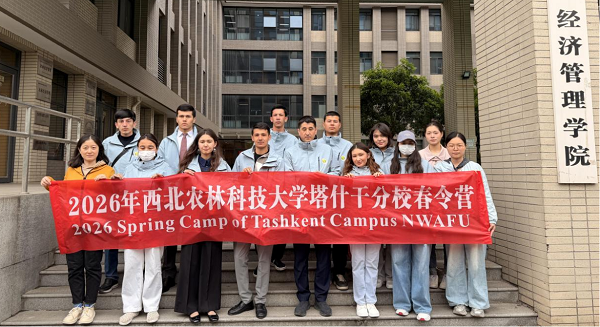
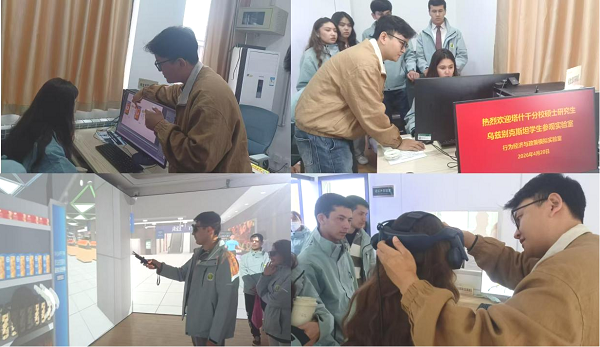
The campers first visited the Behavioral Economics and Policy Simulation Laboratory of the college. The doctoral team led by Professor Ren Yanjun gave a detailed introduction. The campers experienced the virtual reality (VR) system up close and took part in the “Virtual Supermarket” consumption decision-making experiment immersively. In the highly restored virtual shopping scene, they completed product selection, price judgment and purchase decisions from the perspective of consumers, and learned how the experimental platform collects behavioral data in real time and analyzes the impacts of factors such as environment and information presentation on consumption choices. They intuitively experienced the complete process of behavioral economics research from scene construction to behavior analysis. This interactive experience integrating technology and academics was eye-opening for the campers, allowing them to personally feel the innovative vitality of interdisciplinary research, and they spoke highly of the college’s scientific research platform construction.
During the academic symposium, Associate Professor Yan Xiaohuan was invited to deliver a case report entitled China’s Practice of Poverty Alleviation by Science and Technology — Cases from Apple Production Region. Combining China’s distinctive science and technology-driven poverty alleviation practices, Professor Yan systematically explained China’s experience and paths in empowering industrial development and boosting rural revitalization through technology, taking major apple-producing areas as examples. The report aroused enthusiastic responses among the campers, who all stated that it was of both theoretical depth and practical value, providing useful references for China-Uzbekistan agricultural cooperation and rural development exchanges.
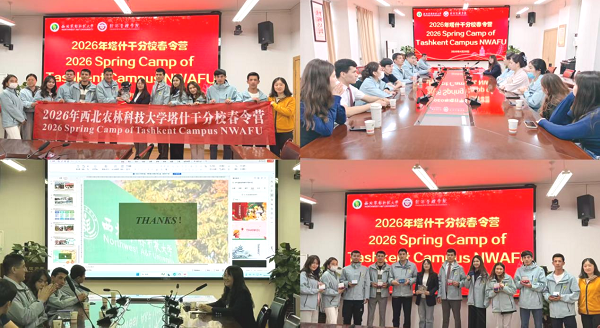
In the interactive session, campers spoke enthusiastically based on their own learning experience and future study plans, creating a harmonious and lively atmosphere. At the end of the event, Chinese and Uzbek teachers and students exchanged souvenirs, drawing a successful conclusion to the spring camp sub-camp activity.
This spring camp sub-camp is another important event held by the college for the Tashkent Campus following the winter camp sub-camp in December last year. As one of the first colleges to recruit students for the Tashkent Campus, the college attaches great importance to all activities of the campus. In the future, the college will further deepen teaching collaboration and cooperative education with the Tashkent Campus, attract more outstanding overseas young people to study here, and contribute to educational cooperation and talent exchanges between China and Uzbekistan under the framework of the Belt and Road Initiative.