
In the golden month of September, as the campus filled with the fragrance of sweet osmanthus, an academic and practical symphony that transcends mountains and seas quietly unfolded in the laboratories and experimental fields of the Small Berry Team at the College of Horticulture. The first group of five master’s students from Tashkent Campus NWAFU arrived as scheduled, carrying with them a thirst for knowledge and a curiosity about China’s agricultural civilization. Among them, three students—A Wazi, A Jizi, and Kai Gang—have already joined the Small Berry Team, participating in the establishment of a modern virus-free rapid propagation base for small berries, and engaging in tasks such as planting elite strawberry lines and cutting seedlings. This marks not only the first lesson of their study-abroad journey in China, but also the beginning of a “berry adventure,” where they can personally connect with the pulse of China’s agricultural science and technology and grow alongside this land.
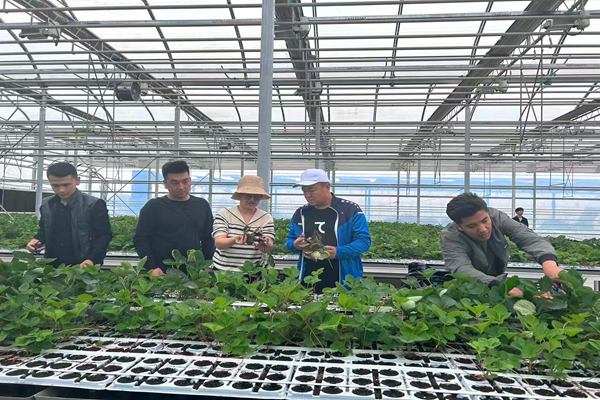
A Wazi developed a strong interest in horticultural technology during his undergraduate studies and is determined to become an expert in horticultural industry technologies. A Jizi has a particular passion for plant micropropagation and aspires to become a leading specialist in plant biotechnology, contributing to agricultural development and advancing sustainable horticultural practices. Kai Gang, who has substantial work experience and comes from a farming family, hopes to develop new strawberry varieties for both his family’s farm and his country. Their decision to join the Small Berry Team stems from the team’s strong expertise in disease-resistant breeding, cultivation, and biotechnology applications related to small berries such as strawberries, grapes, blueberries, and raspberries. This aligns closely with their personal academic aspirations as well as the development needs of modern agriculture in Uzbekistan.
Upon arrival, even before fully adjusting to the time difference, the three international students proactively volunteered to join the Small Berry Team’s busy yet well-organized research activities. In Yangling, Shaanxi Province, September is a crucial period for strawberry propagation and planting. The team was in the process of transplanting carefully selected elite strawberry lines—potential varieties that have been bred over many years and exhibit outstanding performance in disease resistance, fruit flavor, and storage and transport durability. Professor Wen Yingqiang and Associate Professor Feng Jiayue patiently explained the key technical points. The three students gently cradled the tender strawberry seedlings and planted them in the greenhouse. During the critical stage of soil preparation for planting, Kai Gang took the initiative to help. After the workers had finished for the day, he climbed into the tractor cab and skillfully operated the machinery to till the soil and form raised beds. After completing the field preparation, he drove a box truck back and forth to the nursery, ensuring the delicate strawberry seedlings were safely transported to the field.
Inside the intelligent temperature-controlled greenhouse, strawberry cutting propagation was underway. Team members skillfully selected vigorous stolon seedlings, trimmed them into standard cuttings, and inserted them into prepared plug trays. A Wazi, A Jizi, and Kai Gang followed the pace of their Chinese teammates, learning sterilization procedures and practicing trimming techniques. At first, their movements were a bit unfamiliar, but with hands-on guidance from their mentors and language support from team member A Limu, they soon became capable of independently completing high-quality cutting tasks. The other two Tashkent branch students who arrived at the same time also took part enthusiastically. Although their lab coats were soaked with sweat, their eyes shone with excitement and curiosity. Through this “learning by doing” approach, they quickly overcame language and theoretical barriers, gaining a direct understanding of the essence of plant asexual reproduction and the importance of ensuring the purity and health of propagation materials.
If planting and cutting propagation are considered routine research operations, then participating in the establishment of the “Small Berry Virus-Free Rapid Propagation Base” allowed the three international students to encounter one of the core frontiers of China’s agricultural science and technology. Small berries—especially strawberries—are highly susceptible to viral infections, which can lead to varietal degeneration and declines in yield and quality. Building a virus-free rapid propagation system involves using biotechnological methods such as shoot-tip culture and heat treatment to obtain mother plants free of specific viruses. On this basis, factory-based and standardized rapid propagation can be carried out, providing healthy and genetically pure seedlings for agricultural production.
At the construction site of the base, they assisted teachers and technicians in transporting, installing, and testing laboratory benches, tissue-culture racks, and laminar flow cabinets. A Wazi and A Jizi showed great interest in the layers of vibrant green plantlets growing in the illuminated incubators inside the tissue-culture room. During field operations, as Ms. Feng Jiayao taught them hand-in-hand, they also shared videos of their own tissue-culture work conducted in Tashkent, engaging in mutual exchange. This base—now transforming from blueprint to reality—is not only a future “cradle” of high-quality seedlings, but also the best classroom for the three students to understand the starting point of the entire modern horticultural industry chain. Through hands-on practice, they came to realize that these fundamental tasks before them are indeed the cornerstone of agricultural modernization and food security.
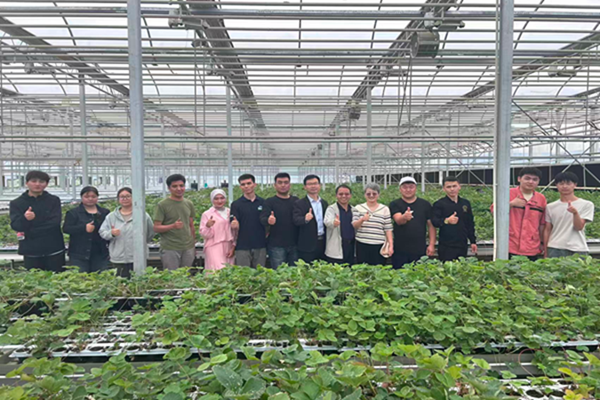
During their shared work and study, the three international students quickly developed deep friendships with Chinese teachers and students. Language was no longer a barrier—gestures, simple Chinese words, English, and a shared passion for scientific research together formed diverse channels of communication. During breaks, they exchanged the food cultures of China and Uzbekistan. In the laboratory, they learned from each other the names of plants and tools in Chinese and Uzbek. In the fields, they shared the common challenges their countries face in agricultural production as well as the different kinds of wisdom used to solve them.
Professor Wen Yingqiang, head of the Small Berry Team, noted that the three international students demonstrated exceptional enthusiasm and strong hands-on abilities. Their arrival has injected new vitality into the team, and their perspectives and questions have at times offered fresh insights. This kind of mutual exchange and intellectual collision is precisely what cooperative education aims to foster. “We have felt not only the presence of advanced technologies here, but also a deep respect and love for the land, the crops, and science. The diligence, rigor, and kindness of the Chinese teachers and students helped us quickly adapt and fall in love with this place,” the three students shared.