
Since July 2024, our university has officially inaugurated and put into operation its overseas campus at Tashkent State Agrarian University in Uzbekistan, and has established an overseas agricultural science and technology demonstration park. These initiatives have created an innovative platform for international talent cultivation, scientific and technological exchange and cooperation, and the development of agriculture-related think tanks between the two universities.
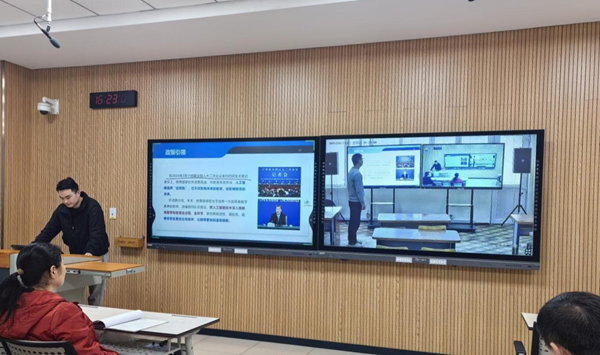
To further deepen cooperation and achieve the sharing and interaction of educational resources between the two universities, the Office of International Cooperation and Exchange and the Office of Information Management actively organized efforts to build a testing environment based on our university’s Smart Teaching Cloud Platform. Ultimately, we successfully enabled both campuses to participate in the same class across national borders. This initiative breaks geographical barriers, allowing students in different countries to attend the same lecture simultaneously and experience teaching styles and academic atmospheres shaped by diverse cultural backgrounds.
The Tashkent Campus has relatively weak infrastructure and a poor network environment. With limited outbound bandwidth, it is difficult to meet the requirements of interactive remote teaching. In response to this challenge, our university actively coordinated with China Unicom and Nanjing Lanzhong Intelligent Technology Co., Ltd. to expand testing bandwidth, provide interactive cloud boxes and SD-WAN equipment, and dispatch specialists to Tashkent for joint debugging. Ultimately, the installation and calibration of all equipment were successfully completed, reducing network latency to within 100 ms and providing robust infrastructure and strong network support for the smooth implementation of cross-border teaching.
Relying on our university’s powerful Smart Teaching Cloud Platform, cross-border teaching between the two campuses has realized a variety of convenient functions. During the class, real-time translation between Chinese, English, and Russian can be enabled. Regardless of the language used by the instructor, students can easily understand the content, effectively eliminating language barriers. Meanwhile, the platform also supports functions such as recording courses, digital whiteboard content, and lecture PowerPoint slides, ensuring that every class is fully documented. Students can review the recorded sessions at any time after class, making it easier to revisit and consolidate what they have learned, thus further enhancing their learning outcomes.
This teaching practice carried out at our university’s Tashkent Campus in Uzbekistan serves as a vivid example of our active implementation of the Belt and Road Initiative. It has provided valuable experience for expanding and deepening future educational cooperation with more international partners.