
On December 21, President Wu Pute published a signed article titled A Landmark Project in the Development of Agricultural Education in Uzbekistan’s authoritative national media outlet, People’s Word. The article systematically outlined the achievements and innovative practices of our Tashkent Campus as a landmark project implementing the consensus reached by the two countries’ heads of state, highlighting its role in supporting regional agricultural modernization. The full text is as follows:
Uzbekistan and China have witnessed flourishing cooperation in education and science, cultivating professional talent for key industries and supporting regional development. Within the framework of priority tasks identified by the two heads of state, Northwest A&F University of China and Tashkent State Agrarian University have jointly established a branch campus in the capital of Uzbekistan, Tashkent, which has already achieved remarkable results.
The establishment of the branch campus was included in the agenda of Uzbek President Shavkat Miromonovich Mirziyoyev’s 2024 state visit to China, during which both sides reached an agreement. In July of last year, the inauguration ceremony was attended by Huai Jinpeng, Minister of Education of the People’s Republic of China, Ibrokhim Yulchiyevich Abdurakhmonov, Minister of Agriculture Resources of the Republic of Uzbekistan, and the president and the rector of both universities. Since then, leadership exchanges between the two universities have taken place over ten times, continuously enhancing the level of cooperation.
In recent years, our university has deepened its engagement with Central Asia and countries jointly participating in the Belt and Road Initiative, actively promoting higher education and scientific cooperation in agriculture and forestry as well as innovative educational models. Comprehensive cooperation with Tashkent State Agrarian University had already begun even before the establishment of the branch campus.
In 2019, leadership exchanges between the two universities led to the signing of a memorandum of cooperation, laying a solid foundation for collaboration. In 2022, a memorandum of understanding on joint education was signed, advancing the partnership into a more concrete phase. In 2023, agreements on joint training for agricultural master’s students and the establishment of the China–Uzbekistan Smart Agriculture Joint Laboratory were implemented. During the same period, graduate students in the Silk Road International Agricultural Talent program undertook internships in Uzbekistan, and Tashkent Chinese Language Education Center of the Northwest A&F University was inaugurated.
Within the framework of the joint training initiative, the two universities established a “1+1” master’s program, in which students spend the first year at Tashkent State Agrarian University and the second year at Northwest A&F University. This program focuses on five key areas: agronomy, horticulture, plant protection, animal science, and economic management. The program structure integrates local demand in Uzbekistan with Chinese international education standards, helping to cultivate high-quality interdisciplinary talents.
The program demonstrates sustainable vitality, with its institutional foundation continuously strengthened. The campus has established a modern management system that includes a joint management committee and functional departments, gradually improving mechanisms for decision-making, quality assurance, and plan implementation. Through the deployment of dedicated staff and the formulation of internal regulations, the campus ensures the stability of teaching processes and the enhancement of management efficiency.
The program is designed to meet regional needs. The campus has developed a curriculum system combining “international standards + regional characteristics,” implemented a dual-mentor system, and explored mechanisms for credit recognition and joint training. To date, two cohorts totaling 40 master’s students have been enrolled, covering five key disciplines including agronomy and plant protection. More than 30 core faculty members have been dispatched to the campus to teach eight core courses, totaling nearly 200 class hours. In June 2025, ten Uzbek teachers came to China for professional training. Drawing on experiences from overseas agricultural science and technology demonstration parks, the campus has established an integrated training chain linking “classroom—laboratory—field—industry,” promoting a close alignment between talent cultivation and industrial development.
Research collaboration empowers regional development. Leveraging platforms such as the China–Uzbekistan Smart Agriculture Joint Laboratory, both sides focus on joint research in areas such as water-saving agriculture and germplasm innovation, promoting the localization of research outcomes. A key focus is improving the yield and quality of Uzbekistan’s major horticultural crop—apples. The campus applies modern genetic breeding, soil nutrient analysis, and intelligent monitoring technologies to promote scientific orchard management. The demonstration apple orchards serve both production and research purposes, testing and implementing techniques to enhance tree vigor, improve fruit quality, and reduce costs. These practices generate replicable and scalable experience, providing solutions for the modernization of Uzbekistan’s horticultural industry.
Cultural exchange builds communication bridges. The campus has established a Chinese Language Education Center, where six teachers carry out international Chinese language education, reaching approximately 700 participants in total and using teaching materials provided by the UNDP and relevant China–Uzbekistan institutions. Through the “Chinese + professional studies” training model, students’ cross-cultural communication abilities have been enhanced, fostering people-to-people exchange and mutual understanding of civilization between China and Uzbekistan.
In July 2025, the teaching building of the campus was officially put into use, completing the renovation of the first phase of teaching and office spaces, with smart classrooms and a cross-border teaching network now operational. Looking ahead, the campus will align with national strategies for strengthening education, science and technology, and talent development, while responding to the high-quality development goals of the Belt and Road Initiative and Uzbekistan’s Uzbekistan-2030 strategy. Efforts will continue across five key areas: deepening talent cultivation, strengthening science and innovation platforms, building a robust faculty team, enriching the humanistic foundation, and enhancing digital empowerment.
Our core objective is to establish a landmark project that embodies the consensus of the two countries’ leaders and serves regional agricultural modernization. Guided by the principles of consultation, joint construction, and shared benefits, the two universities are committed to developing the Tashkent Campus into a “golden emblem” of China–Uzbekistan educational cooperation and a “new benchmark” for internationalized higher education in agriculture and forestry, making new and greater contributions to deepening the China–Uzbekistan comprehensive strategic partnership and building a community with a shared future for mankind.
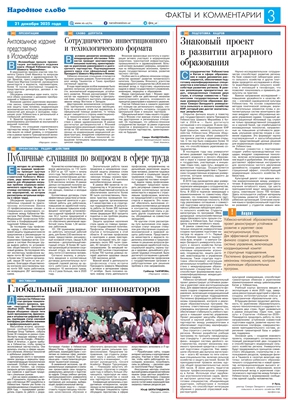
People's Word (Народное Слово, in Uzbek: Халқ сўзи) is Uzbekistan’s authoritative national newspaper and an official government publication, jointly sponsored by the country’s highest legislative and executive bodies—the Parliament and the Cabinet. The newspaper has long served as an authoritative platform for the release of core government policies, providing comprehensive coverage of major official events and in-depth analysis of the country’s reform processes. Its content directly reflects government intent and development strategies. The newspaper is not only the primary source of authoritative information for the domestic public in Uzbekistan but also a key window and important barometer for the international community to observe Uzbekistan’s political trends, economic developments, and social changes.