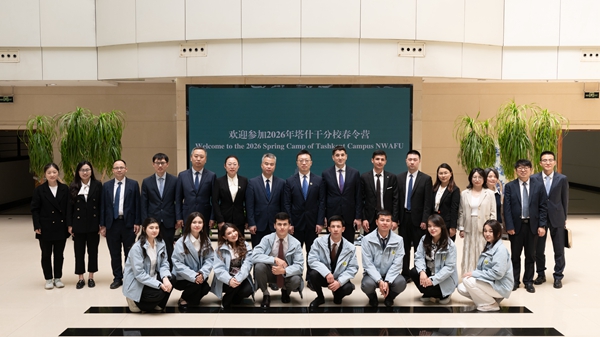
On April 15th, the 2026 Spring Camp of Tashkent Campus NWAFU was officially launched. Zhang Hongming, Vice President of NWAFU, Chen Gang, Director of the Central Asia Division of the Foreign Affairs Office of Shaanxi Provincial People’s Government and Oblomuradov Narzullo, Rector of Tashkent State Agrarian University attended the opining ceremony. Responsible officials from the Tashkent Campus, the Office of International Cooperation and Exchange, the College of Agronomy, the College of Plant Protection, the College of Horticulture, the College of Animal Science and Technology, the College of Information Engineering, the College of Life Science, the College of Economics and Management participated in the event.
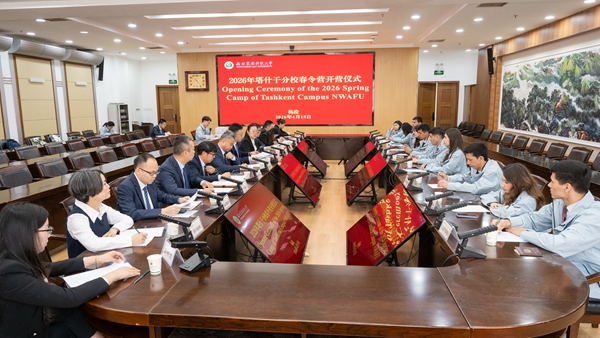
Zhang Hongming, on behalf of Northwest A&F University, extended a warm welcome to the faculty and students participating in the 2026 Spring Camp of Tashkent Campus NWAFU. He briefly introduced the university's history, disciplinary strengths, foundation for international student education, and achievements in internationalization. He highlighted the significance and construction progress of the Tashkent Campus as a diplomatic achievement of the heads of state of China and Uzbekistan. President Zhang expressed the hope that the students would cherish this opportunity, study diligently, gain a deep understanding of China’s traditional culture and modern agricultural development achievements, and experience a realistic, multi-dimensional, and comprehensive China. He encouraged them to bring back to Uzbekistan what they have learned during their stay in China, and to actively become participants, promoters, and ambassadors of China-Uzbekistan friendly exchanges.
Chen Gang stated that this Spring Camp constitutes a significant measure aimed at serving the overall interests of China‑Central Asia cooperation and at implementing the priority cooperation direction of agricultural modernization. It demonstrates the responsibility of NWAFU in fostering agricultural education cooperation and in participating in the construction of a China‑Central Asia community with a shared future. Chen Gang expressed his hope that, through a range of activities including classroom instruction, field-based practice, laboratory experiments, and cultural site visits, the members of the spring camp would be able to immerse themselves in China’s profound farming culture, closely observe the tangible accomplishments of China’s agricultural development, and gain deep insights into the “code” for China’s “two miracles” — namely, rapid economic expansion and enduring social stability.
Rector Oblomuradov Narzullo spoke highly of the achievements of the in-depth cooperation between the two universities in recent years. He particularly noted that, thanks to the joint efforts of both sides, the Tashkent Campus NWAFU has been successfully established and put into operation, providing young students from Uzbekistan and Central Asian region with a valuable international platform for learning and research, and enabling more students to share the academic resources and global vision of NWAFU. He expressed that Tashkent State Agrarian University will continue to actively advance practical cooperation with NWAFU and work for even more fruitful outcomes.
Representatives from the College of Horticulture and the College of Language and Culture, along with teacher and student representatives of the Spring Camp, delivered speeches at the ceremony. This 10-day Spring Camp serves as an important bridging platform for the Tashkent Campus to advance enrollment promotion and cultivate high-level agricultural talents. It features an integrated design of “experience-understanding-enrollment application”. Through a series of concentrated activities including campus visits, course experiences, research platform tours, and cultural exchange events, Uzbek students are able to systematically understand, within a short span of time, the university’s academic strengths, the achievements of China’s modern agricultural development, and the talent cultivation of the Tashkent Campus. During these exchanges, trust is built, laying a solid foundation for subsequent enrollment mobilization, project application, and talent cultivation.