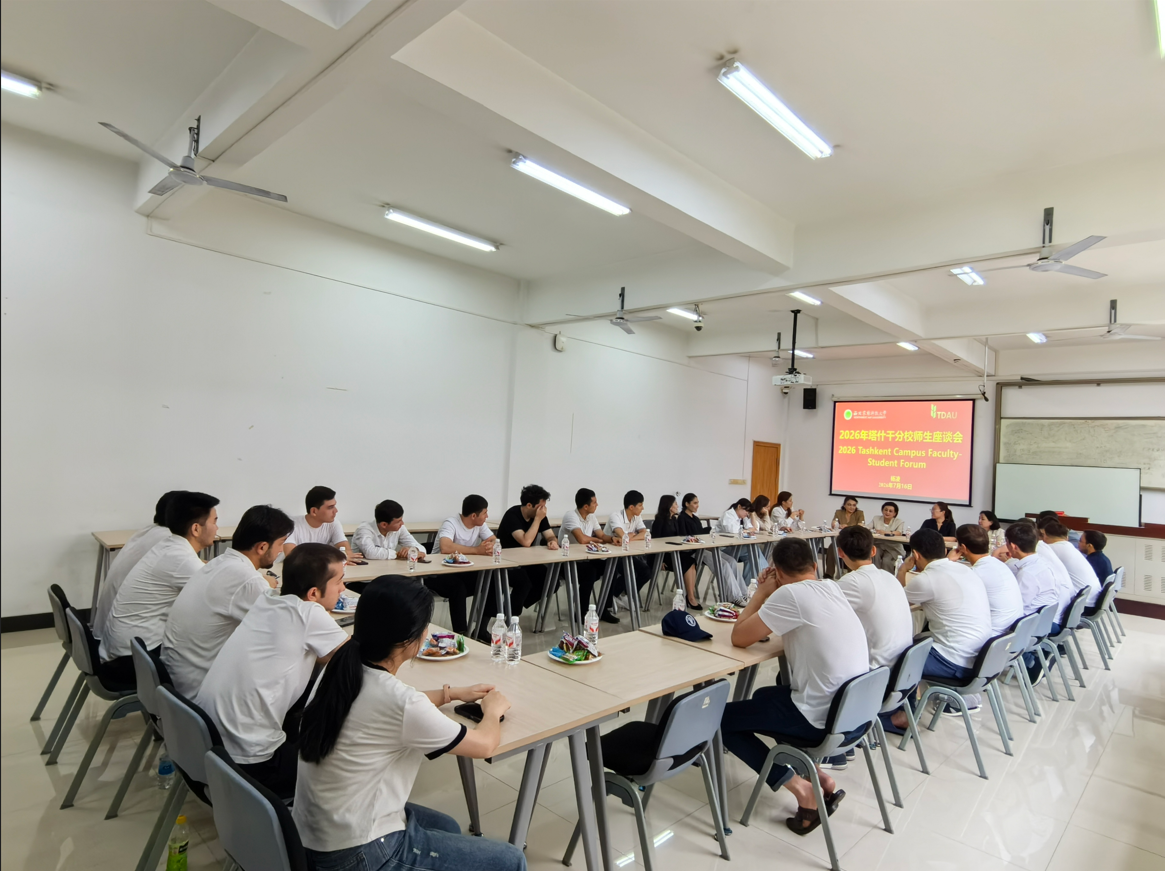
On July 16, the 2026 Tashkent Campus Faculty-Student Forum was successfully held. The forum was chaired by Hu Xiaohui, President of the Tashkent Campus and Dean of the College of International Education, NWAFU. More than 30 participants attended the forum, including faculty members of the Tashkent Campus Faculty Training Program and the Tashkent Campus’ second cohort students, who were pursuing their studies and exchanges at NWAFU.
In her remarks, Hu Xiaohui extended a warm welcome once again to the faculty and students from Tashkent Campus who came to study and exchange at NWAFU. She also fully affirmed the positive progress made by Chinese and Uzbek faculty members in laboratory visits, academic seminars, special lectures, and research collaboration. She noted that the two universities each have their own strengths in cutting-edge disciplinary research and agricultural production practices, and are highly complementary. She expressed the hope that faculty members from both sides would further strengthen exchanges and mutual learning, deepen research collaboration, and continue to expand the scope of cooperation between the two institutions. Regarding the academic arrangements for the students studying in China, she emphasized that NWAFU has assigned professional supervisors to each student and, based on actual needs, has offered Chinese language training courses to help students improve their research capabilities and Chinese proficiency. She also expressed the hope that students would make sound academic plans, diligently prepare for their thesis proposal defense, and pass the HSK Level 3 examination with excellent results, while striving to obtain scholarships. She also noted that the university will carefully listen to the opinions and suggestions of both faculty and students, actively coordinate and address reasonable requests, and provide strong support for their study, work, and daily life on campus.
At the forum, Sardorjon Avazov, Head of the Department of Agricultural Phytopathology, Saydali Turdiev, Professor of the Department of Forestry and Landscape Design and Rano Yuldasheva, Professor of Plant Breeding and Seed Production of Agricultural Crops of Tashkent State Agrarian University, delivered speeches. They expressed their gratitude to the university for the thoughtful arrangements in training programs, research exchanges, and living services. Drawing on their respective areas of expertise, they offered suggestions and recommendations on strengthening research project collaboration, improving the China-Uzbekistan dual-supervisor training mechanism, and promoting regular exchanges between faculty and students. They also noted that they would fully leverage their professional strengths and actively participate in the development of the Tashkent Campus, striving to make greater contributions to deepening the cooperation between the two universities and serving the agricultural development of China and Uzbekistan.
The participating students shared their reflections on their learning and living experiences since arriving in China, covering areas such as specialized coursework, supervisor guidance, research practice, Chinese language training, and campus life. They also put forward opinions and suggestions regarding their subsequent study arrangements. The relevant staff members carefully recorded the needs and requests raised by the faculty and students, and provided on-site responses to the issues concerned.
The Tashkent Campus Faculty Training Program runs for 21 days. Participating faculty members have been assigned to six academic colleges, including the College of Agronomy, the College of Plant Protection, and the College of Animal Science and Technology. Through immersive classroom learning, laboratory exchanges, special lectures, academic seminars, and om-site field visits, they will gained an in-depth understanding of NWAFU’s talent cultivation, scientific research, and social service activities. During the training, the participants will also visit the Terracotta Warriors and the Qinling Giant Panda Research Center, to experience China’s fine traditional culture and appreciate the achievements of its ecological civilization.