

From November 2 to 4, President Wu Pute visited Tashkent, Uzbekistan, at the invitation of the organizers to attend the Second Uzbekistan–China Education Forum. He also visited several partner universities to advance practical cooperation. Vice President Zhang Hongming, the head of the Office of International Cooperation and Exchange, and a faculty representative from the College of Horticulture accompanied the delegation.
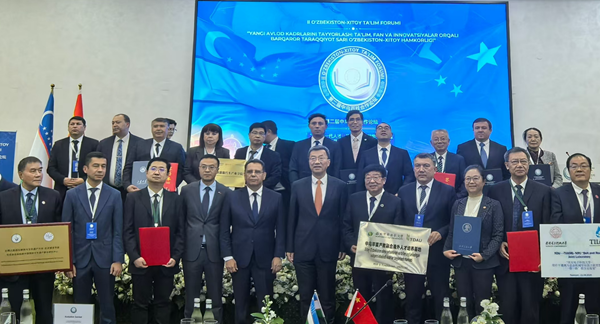
Minister of Education Huai Jinpeng Witnesses the Unveiling of Our University’s Overseas Talent Training Base
The forum was held at the Uzbekistan State World Languages University, aiming to deepen joint talent training between China and Uzbekistan, promote exchanges between faculty and students, and build a mutually beneficial cooperation platform. Attendees included Huai Jinpeng, Minister of Education of the People’s Republic of China; Sharipov Kongratbay Avezimbetovich, Minister of Higher Education, Science and Innovation of the Republic of Uzbekistan; and Wang Jiwei, Chargé d’Affaires of the Embassy of the People's Republic of China in the Republic of Uzbekistan, all of whom delivered speeches.
Under the witness of Huai Jinpeng and Sharipov Kongratbay Avezimbetovich, our university’s China–Uzbekistan Apple Industry–Education Integration Overseas Talent Training Base was officially inaugurated. This marks a shift in China–Uzbekistan cooperation from traditional educational exchanges to a model of industry–education collaboration empowering the sector, injecting a “China solution” into the revitalization of Central Asia’s specialty agriculture.
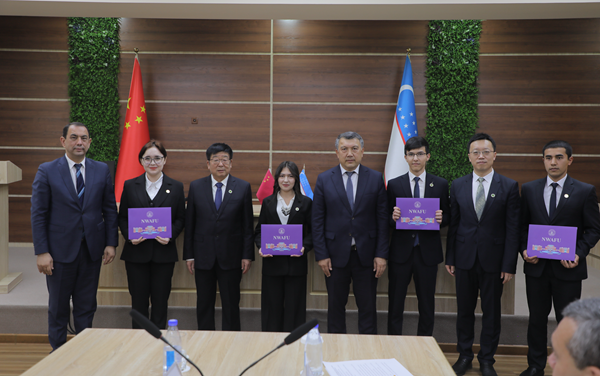
Wu Pute Presents Admission Letters to the Class of 2025 at Tashkent Campus NWAFU
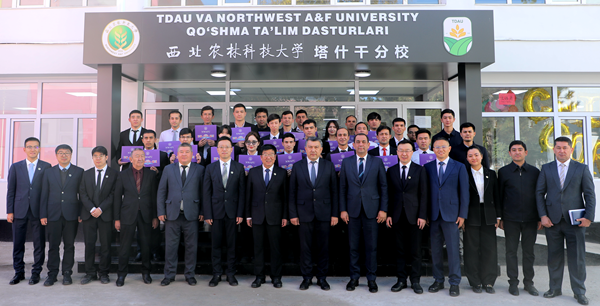
Group Photo of All Participants at the Tashkent Campus NWAFU
During the forum, Wu Pute delivered a keynote speech titled "China–Uzbekistan Integration, Joint Talent Development: The Talent Training Path of Tashkent Campus NWAFU", systematically sharing the “NWAFU experience” in building overseas branch campuses. He emphasized that China and Uzbekistan share compatible development philosophies and aligned goals. Our university has always been committed to implementing the consensus reached by the two countries’ leaders, conducting practical cooperation with multiple Uzbek agricultural universities. We have successfully established Tashkent Campus NWAFU, setting a model for China-Uzbekistan agricultural science and education collaboration.
During the forum, Wu Pute and his delegation paid a special visit to Tashkent State Agrarian University, where they, together with the university’s Rector Oblomuradov Narzullo Naimovich, a representative from the Ministry of Agriculture of the Republic of Uzbekistan, and the full administrative team of the university, attended the opening ceremony for the Cohort of 2025 at our Tashkent campus. During the ceremony, as the new students touched the university badges bearing the motto “Sincerity, Simplicity, Bravery and Perseverance”, they embodied a vivid symbol of China–Uzbekistan educational integration. The badges not only represent their identity but also carry forward the shared mission of agricultural scientists from both countries to address people’s livelihoods. In the “first lesson of the semester”, Wu Pute framed his talk around the university’s history, explaining NWAFU’s founding principles of “managing state fundamentals, solving civilian livelihood, and respecting scientific research”, and emphasized that Tashkent Campus NWAFU represents the extension and practical implementation of these principles in Central Asia.
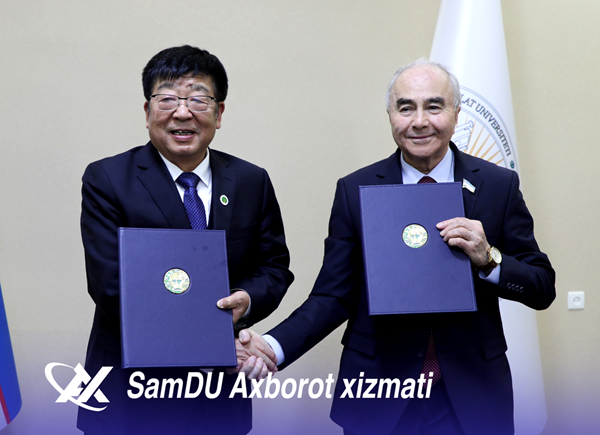
Our University Signs Inter-University Cooperation Agreement with Samarkand State University
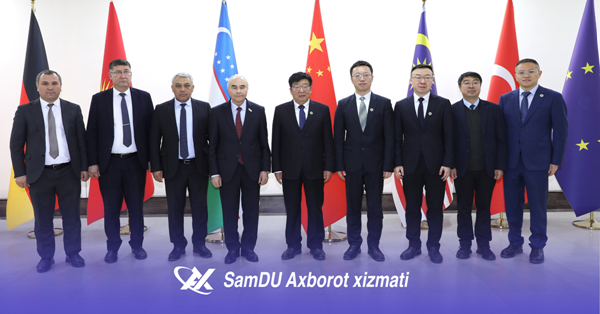
Wu Pute Visits Samarkand State University
After the forum, Wu Pute led a delegation to visit Samarkand State University, where he held in-depth discussions with Rector Khalmuradov Rustam Ibragimovich. The two sides reached multiple agreements on joint discipline development, research collaboration, and talent training, and jointly signed an inter-university cooperation agreement.
Wu Pute noted that the agricultural characteristics of Samarkand region closely align with those of China’s northwestern arid and semi-arid areas. In the future, cooperation could focus on the efficient use of arid agricultural resources and the genetic improvement of specialty crops, deeply integrating Samarkand State University’s local research foundation with our university’s technological strengths and the educational system of Tashkent Campus NWAFU, injecting new momentum into China–Uzbekistan regional collaboration. He emphasized that, from the establishment of Tashkent Campus NWAFU to deep collaboration with Samarkand State University, our university is gradually building a China–Uzbekistan agricultural education network that links pilot initiatives with broader regional coordination. Going forward, teaching collaboration and resource sharing between the two universities will be promoted, enabling Chinese agricultural science, technology, and educational experience to better serve the improvement of livelihoods and industrial upgrading in Central Asia.